
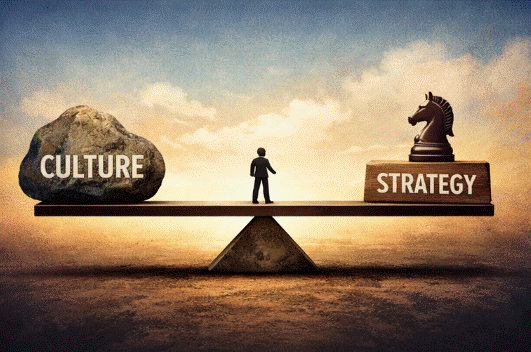

If you’ve ever seen a well-designed plan stall—or quietly fail—you’ve already seen this principle at work.
Most strategies are logical. They’re built on analysis, insights, and clear objectives. On paper, they make sense.
But organizations don’t operate on paper. They operate through individuals interacting for what’s meant to be a common goal.
Culture is often described as “how things get done around here.” It’s the informal system that shapes how decisions are made, how teams communicate, and how accountable people feel for outcomes.
But here’s the reality: if your strategy requires people to behave differently than they currently do, culture will almost always win.
Not because people are resistant, but because culture is deeply embedded. It creates consistency and stability—what some describe as organizational “inertia.”
That inertia can be a strength. It can also quietly undermine even the most thoughtful strategic plan.
Looking for Alignment
The risk with “culture eats strategy for lunch” is that it suggests a hierarchy—as if culture matters and strategy doesn’t.
In practice, that’s not how organizations succeed.
Strategy and culture are not competing forces. They’re interdependent.
A strong culture without direction leads to alignment without progress.
A strong strategy without cultural alignment leads to frustration without execution.
The more accurate interpretation is this:
strategy sets direction, but culture determines whether you can actually get there.
One without the other creates imbalance.
And this is where many leadership teams get stuck.
They invest time building strategy—often through offsites, planning sessions, or external advisors—but underestimate the effort required to align the organization behind it.
Or, they focus heavily on culture—values statements, engagement initiatives—but without clearly connecting those efforts to business outcomes.
In both cases, execution suffers.

The Real Leadership Challenge
For leaders, the question isn’t whether culture or strategy is more important. It’s how well the two are aligned.
That alignment can show up in very practical ways:
- Do your stated priorities match how decisions are actually made?
- Are leaders modelling the behaviours required to execute the strategy?
- Do teams understand not just what needs to change, but why?
Because culture doesn’t change through messaging. It changes through consistent behaviour—especially from leadership.
One of the more useful perspectives I’ve seen is that culture is reinforced (or reshaped) through everyday actions: what gets recognized, what gets challenged, and what gets tolerated.
It’s a reality for the sports world as well. A message I’ve heard and used among my team coaching peers is, “you’re either coaching it, or allowing it to happen.”
If you’re seeing signals that are contradicting the strategy, people will follow the signals—not the plan.
A More Practical Way to Think About It
Rather than treating culture as something abstract, it’s more useful to think about it as a system you can observe and influence.
If you’re introducing a new strategy, ask:
- What behaviours will this require from our team?
- Where do those behaviours conflict with how we operate today?
- What needs to change—specifically—to close that gap?
That’s where meaningful progress happens. Not in rewriting values statements, but in identifying the practical disconnects between intent and reality. And then working through them—deliberately and consistently.
Bringing It Back to Execution
In smaller and mid-sized organizations, this alignment becomes even more critical.
You don’t have layers of management to absorb misalignment.
Culture is more visible. More immediate. And more influential. Which is why the most effective leadership teams I’ve worked with take a balanced approach:
- They invest in clear, focused strategy
- They actively shape the environment required to execute it
- And they treat communication as a core leadership responsibility—not an afterthought
Because in the end, execution is where value is created.
And execution is where culture and strategy either reinforce each other—or quietly pull in opposite directions.
Final Thought
“Culture eats strategy for lunch” is a useful reminder—but it’s not a conclusion.
If anything, it’s a starting point.
The real work is ensuring your culture and your strategy are working together—so your organization can move forward with clarity, consistency, and confidence.
That’s where sustainable growth tends to happen.